Explanation of SqueezeMeta algorithms
The LCA algorithm
We use a Last Common Ancestor (LCA) algorithm to assign taxa to genes.
For the amino acid sequence of each gene, DIAMOND (blastp) homology searches are
done against the NCBI nr database. A e-value cutoff of 1e-03 is set by default. The
best hit is obtained, and then we select a range of hits (valid hits) having at least 80% of
the bitscore of the best hit and differing in less than 10% identity also with the best hit
(these values can be configured). The LCA of all these hits is obtained, that is, the taxon
common to all hits. This LCA can be found at diverse taxonomic ranks (from phylum to
species). We allow some flexibility in the definition of LCA: a small number of hits
belonging to other taxa than the LCA can be allowed. In this way we deal with putative
transfer events, or incorrect annotations in the database. This value is by default 10% of
the total number of valid hits, but can be set by the user. Also, the minimum number of
hits to the LCA taxa can be set.
An example is shown in the next table:
Gene_ID |
Hit_ID |
Hit_Taxonomy |
Identity |
e_value |
|---|---|---|---|---|
Gene1 |
Hit1 |
Genus: Polaribacter Family: Flavobacteriaceae Order: Flavobacteriales |
75.2 |
1e-94 |
Gene1 |
Hit2 |
Genus: Polaribacter Family: Flavobacteriaceae Order: Flavobacteriales |
71.3 |
6e-88 |
Gene1 |
Hit3 |
Family: Flavobacteriaceae Order: Flavobacteriales |
70.4 |
2e-87 |
Gene1 |
Hit4 |
Genus: Algibacter Family: Flavobacteriaceae Order: Flavobacteriales |
68.0 |
2e-83 |
Gene1 |
Hit5 |
Genus: Rhodospirillum Family: Rhodospirillaceae Order: Rhodospirillales |
60.2 |
6e-68 |
In this case, the four first hits are the valid ones. Hit 5 does not make the identity and e-value thresholds. The LCA for the four valid hits is Family: Flavobacteriaceae, that would be the reported result.
Our LCA algorithm includes strict cut-off identity values for different taxonomic ranks, according to Luo et al. (2014) Nucleic Acids Research 42:e73. This means that hits must pass a minimum (aminoacid) identity level in order to be used for assigning particular taxonomic ranks. These thresholds are:
Hits below these levels cannot be used to make assignments for the corresponding rank. For instance, a protein will not be assigned to species level if it has no hits above 85% identity. Also, a protein will remain unclassified if it has no hits above 40% identity. The inclusion of these thresholds guarantees that no assignments are done based on weak, inconclusive hits. Overall, this results in highly conservative, but also very trustworthy taxonomic annotations.
Taxonomic annotation of eukaryotic ORFs
By default, SqueezeMeta applies Luo et al. (2014) identity cutoffs in order to assign an ORF to a given taxonomic rank (see The LCA algorithm). In our tests, these cutoffs resulted in a very low percentage of annotation for eukaryotic ORFs. We believe that the main reasons are the following:
Those filters were calculated using prokaryotic genomes, and might not be valid in eukaryotes.
Eukaryotes are poorly represented in the databases, leading to lower similarities on average.
The treatment of eukaryotic ORFs will differ depending on how SqueezeMeta.pl, sqm_reads.pl or sqm_longreads.pl are launched, and the result files that are used afterwards.
The raw results produced by SqueezeMeta.pl, sqm_reads.pl and sqm_longreads.pl will apply identity cutoffs to all taxa by default unless the flag
--eukis passed when running the script, in which case the identity cutoffs will only be applied to eukaryotic reads.An exception to this is the final step of the SqueezeMeta pipeline, which runs sqm2tables.py with default parameters, see Step 22: Calculation of summary tables for the project. In that step, both types of results will be produced regardless of whether the
--eukflag is passed or not, see below.
When creating taxonomic aggregate tables with sqm2tables.py (for projects created with SqueezeMeta.pl) and sqmreads2tables.py (for projects created with sqm_reads.pl and sqm_longreads.pl) three sets of results will be generated regardless of whether the –euk flag was passed when running the script.
allfilter files, containing ORF, contig and aggregate taxonomies obtained after applying identity filters to ALL taxa.
prokfilter files, containing ORF, contig and aggregate taxonomies obtained after applying identity filters to prokaryotic taxa only. This would replicate the behaviour of
--eukflag.nofilter files, containing ORF, contig and aggregate taxonomies obtained after applying NO identity filters at all.
The advantage of this method is that there is no need to repeat the whole run to change the behaviour of identity cutoffs.
When using The SQMtools R package to analyze your data, you get to choose the behaviour of identity cutoffs (allfilter, prokfilter, nofilter) through the
tax_modeparameter in theloadSQMandloadSQMlitefunctions (with the default being"prokfilter", i.e. using identity cutoffs for prokaryotes but not eukaryotes).
Handling of unclassified and missing ranks in NCBI taxonomy
Note
The discussion below applies only to the results generated by sqm2tables.py (which it itself ran as the final step of the SqueezeMeta pipeline, see Step 22: Calculation of summary tables for the project) and sqmreads2tables.py, and also when loading projects in R with The SQMtools R package. Other SqueezeMeta scripts will not correct for this and report taxonomies directly as received from NCBI.
SqueezeMeta uses NCBI’s nr database for taxonomic annotation, and reports the superkingdom, phylum, class, order, family, genus and species ranks. In some cases, the NCBI taxonomy is missing some intermediate ranks. For example, the NCBI taxonomy for the order Trichomonadida is:
superkingdom: Eukaryota
no rank: Parabasalia
order: Trichomonadida
NCBI does not assign Trichomonadida to any taxa in the class and phylum ranks. For clarity, sqm2tables.py and sqmreads2tables.py will indicate this by recycling the highest available taxonomy and adding the "(no <rank> in NCBI)" string after it. The scripts will also recycle the highest available taxonomy and use it to populate lower level taxonomic ranks, by adding the "Unclassified" string before it.
For example, ORFs that can be classified down to the Trichomonadida order (which itself lacks class and phylum classifications in NCBI) and that could not be classified at the family level or below will be reported as:
superkingdom: Eukaryota
phylum: Trichomonadida (no phylum in NCBI)
class: Trichomonadida (no class in NCBI)
order: Trichomonadida
family: Unclassified Trichomonadida
genus: Unclassified Trichomonadida
species: Unclassified Trichomonadida
Meaning of “Unmapped”, “Unclassified” and “No CDS” in taxonomy results
Note
The discussion below applies only to the results generated by sqm2tables.py (which it itself ran as the final step of the SqueezeMeta pipeline, see Step 22: Calculation of summary tables for the project) and sqmreads2tables.py, and also when loading projects in R with The SQMtools R package.
The “Unclassified” category represents only the features that were classifiable with our method (i.e. contained a protein-coding sequence) but were not actually classified (because they did not have good enough hits to the reference database).
In addition to the normal taxon names and the “Unclassified” category, the results will contain 2 extra categories:
"Unmapped": reads not mapping to any contigs."No CDS": features (or reads mapping to features) that contained no protein-coding sequences (e.g. rRNAs).
Consensus taxonomic annotation for contigs and bins
The consensus algorithm attempts to obtain a consensus taxonomic annotation for the contigs according to the annotations of each of its genes. The consensus taxon is the one fulfilling the following criteria:
50% of the genes of the contig belong to (are annotated to) this taxon
70% of the annotated genes belong to (are annotated to) this taxon
Notice that the first criterion refers to all genes in the contig, regardless if they have been annotated or not, while the second refers exclusively to annotated genes.
As the assignment can be done at different taxonomic ranks, the consensus is the deepest taxon fulfilling the criteria above.
For instance, consider the following example for a contig with 6 genes:
Gene |
Superkingdom |
Phylum |
Class |
Order |
Family |
Genus |
Species |
|---|---|---|---|---|---|---|---|
Gen1 |
Bacteria |
Pseudomonadota |
Gammaproteobacteria |
Enterobacteriales |
Enterobacteriaceae |
Escherichia |
Escherichia coli |
Gen2 |
Bacteria |
Pseudomonadota |
Gammaproteobacteria |
Enterobacteriales |
Enterobacteriaceae |
Escherichia |
|
Gen3 |
Bacteria |
Pseudomonadota |
Gammaproteobacteria |
Enterobacteriales |
Enterobacteriaceae |
Escherichia |
|
Gen4 |
Bacteria |
Pseudomonadota |
Gammaproteobacteria |
Enterobacteriales |
Enterobacteriaceae |
||
Gen5 |
Unclassified |
||||||
Gen6 |
Bacteria |
Bacillota |
In this case, the contig will be assigned to
the Enterobacteriaceae, family, which is the deepest taxon found in 50% or more of all the genes
(4/6=66%), and in 70% or more of the annotated genes (4/5=80%). The
assignment to genus Escherichia was not done since just 3/5=60% of the annotated genes
belong to it, which is below the cutoff threshold.
For annotating the consensus of bins, the procedure is the same, but using the annotations of the corresponding contigs instead.
Note
The consensus annotation for each bin is derived from the individual annotation of its constituent contigs (itself derived from the annotation of individual ORFs), and thus it will have a limited taxonomic resolution. This is unavoidable for short contigs, but when working with reasonably complete bins a much better taxonomic annotation can be obtained with GTDB-Tk. Adding the --gtdbtk flag while calling SqueezeMeta will produce a GTDB-Tk taxonomy for each bin, in addition to the consensus taxonomy described here.
Disparity calculation
Note that, in the example above, the end part of the contig seems to depart from the common taxonomic origin of the rest. This can be due to misassembly resulting in chimerism, or other causes such as a recent LCA transfer or a wrong annotation for the gene. The disparity index attempts to measure this effect, so that the contigs can be flagged accordingly (for instance, we could decide not trusting contigs with high disparity). It is defined as the fraction of classified ORFs in a contig whose taxonomy differs from the consensus taxonomy of that contig (see Consensus taxonomic annotation for contigs and bins).
For calculating the disparity of bins, the procedure is the same, just using the annotations for the corresponding contigs.
Limitations of taxonomic assignments from shotgun metagenomics data
SqueezeMeta generates taxonomy at the contig level (some scripts do it at the read level instead, but the following discussion also applies). Then it aggregates the taxonomic annotations from each contig to produce count tables at different taxonomic levels.
The contigs are taxonomically annotated by comparing the protein sequences of the genes within to proteins with known taxonomic annotation from a reference database (currently NCBI nr). This is conceptually similar to what we do when annotating 16S rRNA amplicons (e.g. by annotating them against SILVA or other databases).
However, 16S rRNA has two features that make it specially good for taxonomic annotation:
It is easy to amplify and sequence, so our databases have a broad taxonomic coverage.
It evolves at a slow, steady rate (oversimplifying here, but bear with me) so even if the 16S amplicon from our samples is not present in our (already broad) reference database, it is likely that at least a close relative will be in there, close enough to give us a good taxonomic annotation.
In contrast, the rest of the genes in a genome (the ones we retrieve with shotgun metagenomics, and we are trying to annotate with SqueezeMeta) behave in a different way:
In order to build our database we need to sequence full genomes from isolates (so we can associate each gene to a full taxonomy) or at the very least very good quality MAGs (enough to get a good taxonomy e.g. from GTDB-Tk). This is fastidious and expensive so our database will not have such a broad coverage.
They can evolve fast as organisms adapt to new niches. Two phylogenetically close organisms can have higher-than-expected differences in certain ortholog genes, if they have been recently subjected to strong selection. So even if our reference database contains a close-enough relative to the environmental organisms in our sample, it may be that the homology of some of our proteins to the ones in the database is not that high.
These two combined mean that the homologies of our genes to the reference database (and thus our ability to derive taxonomic annotations from them) can vary a lot, between samples (which may contain more or less well-represented clades), clades (which may be better or worse represented in the database) and even genes (since they may be more or less variable within a clade and within different clades).
SqueezeMeta uses a conservative approach in which we only annotate a gene at a certain taxonomic level if the homology is above a certain threshold (very high for a species-level assignment, much lower for a superkingdom-level assignment). What this means is that, for a given taxonomic level (e.g. genus) there will be a certain number of reads that weren’t classified at that level but were classified at higher levels. In SqueezeMeta, we report the highest classifiaction we were able to achieve, so a hypothetical genus-level count table could look like:
Taxon |
Sample1 |
Sample2 |
|---|---|---|
Pseudomonas |
90 |
60 |
Unclassified Pseudomonadaceae |
5 |
28 |
Unclassified Pseudomonadota |
3 |
11 |
Unclassified |
2 |
1 |
It is unclear what to do with these “intermediately-classified” counts, and regardless of whether we keep them or remove them we risk introducing biases in our data. For example, the bona-fide Pseudomonas has a lower abundance in Sample2 than in Sample1, but it could be that all the Unclassified Pseudomonadaceae reads in that sample also belonged to the Pseudomonas genus (just to a different species that was not represented in the database and had diverged from the others in some regions of its genome). Or they could belong to a completely different genus from the Pseudomonadaceae family that was also not represented in the database. There is no way to know by just looking at the often small number of genes contained on a single contig. This problem will become smaller as we move to higher taxonomic ranks, since the homology thresholds for taxonomic assignment become lower, but it never fully disappears (and a superkingdom-level differential abundance analysis may not be that informative!).
A solution could be to derive the taxonomy from MAGs instead of contigs (e.g. using GTDB-Tk), if you have produced them in the metagenome, since in this case we can combine the information from many different marker genes and the annotation will be much more robust. But the MAGs themselves may represent only a fraction of your community since normally not everything gets binned into high-quality MAGs. To circunvent this issue, one could limit taxonomic annotation to marker genes (as done e.g. by MetaPhlan, though MetaPhlan’s reference database appears to be restricted to the human microbiome and may not work that well with other environments).
The fun3 algorithm
Fun3 is the algorithm that produces functional assignments (for COGs, KEGG and
external databases). It reads the DIAMOND BlastX output of the homology search of the
metagenomic genes for these databases. The homology search has been done with the
defined parameters of e-value and identity, so that no hits below above the minimum
e-value or below the minimum identity are found. Also, partial hits (where query and
hits align in less than the percentage given by the user, 30% by default) are discarded.
The hits that pass the filters can correspond to more than one functional ID (for
instance, COG or KEGG ID). Fun3 provides two types of classification: Best hit is just the
functional ID of the highest scoring hit. Best average tries to evaluate also if that
functional ID is significantly better than the rest. For that, it takes the first n hits
corresponding to each functional ID (n set by the user, default is 5) and calculates their
average bitscore. The gene is assigned to the functional ID with the highest average
bitscore that exceeds in a given percentage (given by the user, by default 10%) the
score of the second one. This method reports less assignments but it is also more
precise, avoiding confusions between closely related protein families.
A unique functional assignment, the best hit, is shown in the gene table produced during Step 13: Creation of the ORF table.
There, the functional ID is shown with a * symbol to indicate that the assignment is supported also
by the best average method.
Partial counts for functions in aggregated tables
Note
The discussion below applies only to the results generated by sqm2tables.py (which it itself ran as the final step of the SqueezeMeta pipeline, see Step 22: Calculation of summary tables for the project) and sqmreads2tables.py, and also when loading projects in R with The SQMtools R package.
Some ORFs will have multiple KEGG/COG annotations in the ORF table. This is due to their best hit in the KEGG/COG databases actually being annotated with more than one function. The script will split the abundances of those ORFs between the different functions they have been assigned to, which will preserve the total number of reads in the table, but will lead to fractional counts in some cases. If using those tables with methods that expect integer counts, you can just round them as the error will be minimal.
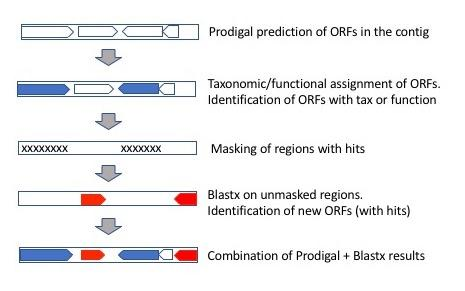
Doublepass: blastx on contig gaps
The -D option activates the doublepass procedure, where regions of the contigs where
no ORFs where predicted, or where these ORFs could not be assigned taxonomically and
functionally, are queried against the databases using blastx. This method allows to
recover putative ORFs missed by Prodigal, or to correct wrongly predicted ORFs. The
following figure illustrates the steps of the doublepass procedure:
The COVER algorithm
COVER (used by the cover.pl) intends to help in the experimental design of metagenomics by addressing the unavoidable question: How much should I sequence to get good results? Or the other way around: I can spend this much money, would it be worth to use it in sequencing the metagenome?
To answer these questions, COVER allows the estimation of the amount of sequencing needed to achieve a particular objective, being this the coverage attained for the most abundant N members of the microbiome. For instance, how much sequence is needed to reach 5x coverage for the four most abundant members (from now on, OTUs). COVER was first published in Tamames et al. (2012), Environ Microbiol Rep. 4:335-41), but we are using a different version of the algorithm described there.
COVER needs information on the composition of the microbiome, and that must be provided as a file containing 16S rRNA sequences obtained by amplicon sequencing of the target microbiome. If you don’t have that, you can look for a similar sample already sequenced (for instance, in NCBI’s SRA, see below).
The first step is clustering the sequences at the desired identity level (default: 98%) to produce OTUs. COVER uses CD-HIT (Fu et al., 2012 Bioinformatics 23:3150-2) for doing this. The abundance of each OTU is also obtained in this step (the number of sequences in each OTU). Then, a taxonomic annotation step must be done for inferring genomic size and 16S rRNA copy number for each of the OTUs. This annotation can be done using the RDP classifier (Wang et al., 2007, Appl Environ Microbiol 73:5261-7), or Mothur (Schloss et al., 2009, Appl Environ Microbiol 75:7537-41) alignment against the SILVA database. The latter is the default option. It is slower but provides more accurate results.
The taxonomic annotation allows to infer the approximate genomic size by comparison with the size of already sequenced genomes from the same taxon (we’ve got this information from NCBI’s genome database). In the same way, we inferred the expected copy number by comparison to the rrnDB database (Stoddard et al., 2015, Nucleic Acids Research 43:D593-8). Obviously, the most accurate the annotation, the most precise this estimation will be. In case that the OTU could not be annotated, COVER uses default values of 4 Mb genomic size and 1 for copy number. These values can be greatly inaccurate and affect the results. Therefore, it is strongly advised that the taxonomic annotation is as good as possible.
In the next step, COVER calculates the probability of sequencing a base for each of the OTUs. First, the abundance of each OTU is divided by its copy number:
Abundance_n = Raw_abundance_n / Copy_number_n
Then, all abundances are summed, and individual abundances are normalized by this total abundance.
Corr_abundance_n = Abundance_n / Σn Abundances
The fraction of the microbiome occupied by each OTU, f, is the product of its abundance by its genomic size
f_n = Corr_abundance_n * Size_n
and the total size of the microbiome is the sum of all individual fractions
F = Σn f_n
Then, the probability of sequencing one base of a particular OTU is the ratio between its fraction and the total size:
p_n = f_n / F
And the amount of sequence needed (S) to attain coverage C for genome n is then:
S = C * Size_n / p_n
COVER calculates this value of S for the n-th OTU, as specified by the user. Then, coverages for all other OTUs are also calculated using the last equation and this value of S:
C_n = S * p_n / Size_n
in the previous calculation, we have assumed that we can calculate abundances for all members of the microbiome. Obviously this is not true, because there will be a fraction of unobserved (rare) OTUs that were not sequenced in our 16S. The size of that fraction will depend on the completeness of our 16S sequencing, which is influenced by the diversity of the microbiome and by the sequencing depth. This unobserved fraction can bias greatly the results. Luckily, there is a way to estimate it by means of the Good’s estimator of sample coverage, that supposses that the fraction of sequence reads corresponding to unobserved OTUs is approximately equal to the fraction of observed singletons (OTUs with just one sequence):
U = f_1 / N_OTUs
Both f_1 and N_OTUs are obtained in the OTU clustering step. Then, we just need to correct the value of S by this value:
S_corrected = S / (1-U)